Wordament® by Microsoft
- 4.2
- Rating
- 1.00M
- Installs
- Free
- Price
 Analysis by App-foxy
I enjoy word games most when they are easy to start but difficult to master, and Wordament® sits firmly in that space. It is a free word game from Microsoft Corporation built around searching for words and solving puzzles, with enough variety to make a short break feel worthwhile. I can open it when I have only a few minutes, yet I can also stay with it longer when I want to chase better results or play alongside other people.
The important decision is not simply whether you like words. It is whether you want a word game that feels active and competitive rather than a quiet crossword or a slow vocabulary exercise. Wordament is a good match for players who enjoy scanning a crowded board, spotting possibilities quickly, and making decisions under pressure. It is less convincing for someone who wants a carefully paced daily puzzle, a long story, or a completely relaxed experience without any sense of urgency.
What makes Wordament worth choosing
I find Wordament most appealing when a word game needs to fit around real life rather than become another commitment. The section ahead looks at what makes its quick-search format worth trying, including how a small change in the way you scan can make short sessions feel more rewarding. From there, I’ll consider whether that early appeal holds up as the weeks go by.
You May Also Like

 Blood Strike: 2.5 Anniversary
Blood Strike’s Loadouts Turn Every Drop Into a Tactical Gamble
A close look at Blood Strike’s custom loadouts: how fast access to signature weapons reshapes its battle royale rhythm, rewards preparation, and narrows the gap between fights.

 Pandora - Music & Podcasts
Pandora’s Music Is Easy to Start, but Harder to Recover
Pandora’s strength is its low-effort path from a seed to a station. Its weak spot is how much confidence it asks you to place in connection, setup, and quiet recovery.

 8 Ball Pool
 Is Built on Rivalries, Rematches, and Routine
A close look at the rivalries, rematches, shared routines, and unanswered safety questions that turn a quick pool match into a persistent mobile community.

 Samsung Music
’s Quiet Strength Is Playing What You Already Own
Its reach comes less from spectacle than from dependable access to a personal library. That simplicity is both the app’s strongest retention engine and its ceiling.

 AccuWeather: Weather Radar
AccuWeather Review: A Quick, Clear Forecast for Everyday Decisions
For everyday plans, the best forecast is the one you can understand quickly. AccuWeather makes rain timing, radar, and local conditions easy to act on, with a few trade-offs.

 Hill Climb Racing
Why Hill Climb Racing Still Turns Crashes Into One More Run
A tiny car, a bumpy hill and one more upgrade: Hill Climb Racing keeps resurfacing because its simple chaos makes every near-miss feel personal.
More From Our News Desk



The basic experience is quick to understand
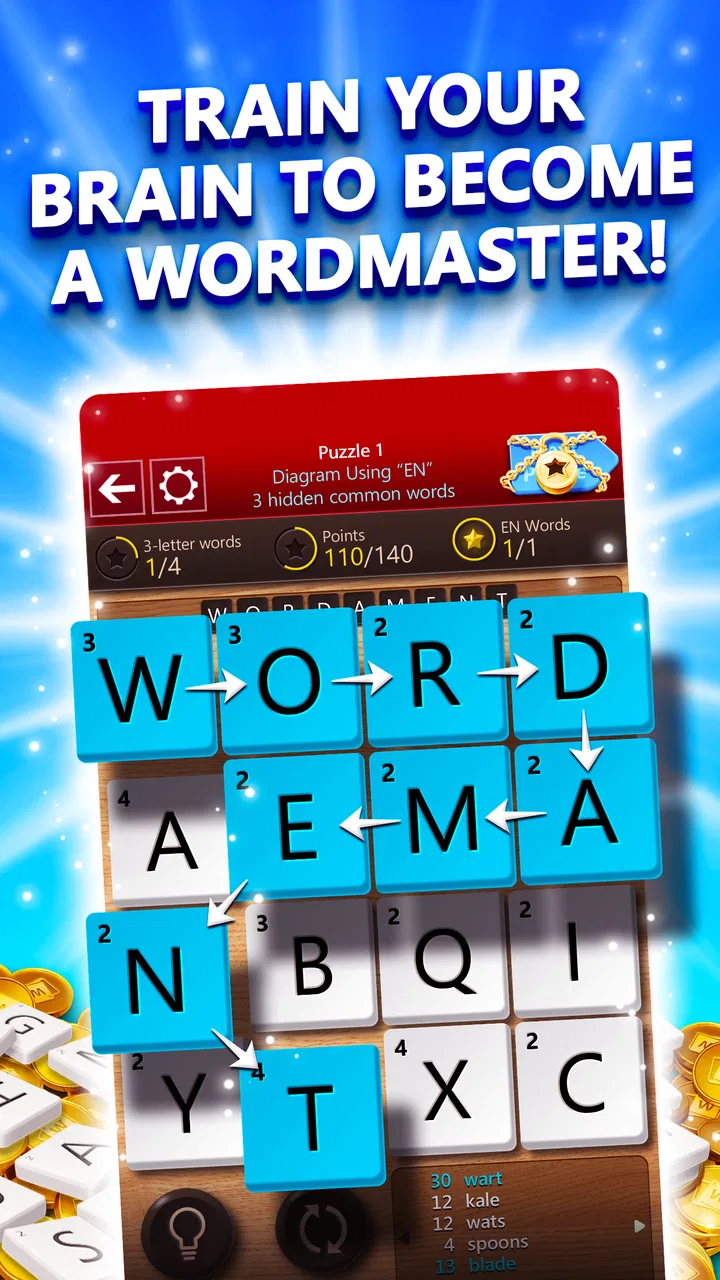
The central idea is approachable: look through the available letters, find words, and solve the puzzle in front of you. I did not need a long explanation before understanding what I was supposed to do. That matters on a phone, where complicated menus or layered instructions can make a casual game feel like work.
At the same time, the simplicity is deceptive. Finding an obvious short word is easy; noticing a less visible combination before the opportunity passes is much harder. The game rewards both vocabulary and visual attention. I often find myself switching between two kinds of thinking: first scanning for familiar patterns, then testing whether a promising path can produce something longer or less predictable.
That combination gives the game a useful middle ground. It is more involved than a basic word scramble, but it does not demand the preparation associated with a traditional crossword. I can play without setting aside a quiet hour, which makes it especially suitable for a commute, a waiting room, or a brief break between tasks.
Why the format works in everyday situations
One realistic use is a short evening session when I want something more engaging than scrolling but do not have the energy for a large game. A round gives me a clear mental task without asking me to remember a complicated plot or manage a large collection of items. If I stop after a few minutes, I still feel that I have completed something.
It also works well as a shared activity. The store description presents it as something to enjoy alone or with friends, and that changes the way I approach it. Playing by myself is useful when I want to focus on improving my own word recognition. Playing with friends adds a social reason to return, especially for people who enjoy comparing discoveries rather than competing through action or reflexes.
The strongest reason to try it is the balance between a tiny time commitment and genuine mental involvement. It is not merely a word list dressed up as a game. The pressure to keep looking, the satisfaction of spotting an overlooked word, and the possibility of playing with others give each session more energy than a static vocabulary exercise.
What I look for before recommending it
When I decide whether a word game deserves space on my phone, I consider four things: how quickly I can begin, whether the challenge remains interesting after the first few sessions, whether it supports my preferred pace, and whether its free model gets in the way. Wordament performs well on the first two points. Its familiar premise is immediately accessible, while the large pool of possible words gives the activity room to remain engaging.
The pace is more personal. Players who enjoy rapid searching will probably appreciate the tension. Players who need time to inspect every letter may find that the experience feels less comfortable than a crossword or a traditional anagram game. I would not call that a flaw in the concept, but it is an important distinction when choosing between word-game styles.
The free entry point is another advantage. I can try the game without paying first, which makes it easy to judge whether the format suits me. There are optional in-app purchases priced from $1.99 to $9.99 per item, so anyone who prefers a strictly no-spend experience should pay attention to the purchase prompts and decide in advance whether the free play is enough.
Small habits that improve the experience
My first practical tip is to avoid staring at one promising letter path for too long. If I become attached to a single possibility, I miss simpler words elsewhere on the board. A better routine is to scan broadly, collect easy finds, and only then return to the areas that look more productive.
A second tip is to treat short words as warm-up clues rather than the entire goal. They help reveal how the letters connect and can draw attention to nearby combinations. After that first pass, I look for extensions and alternate routes instead of repeatedly searching the same obvious area.
A third useful habit is to separate vocabulary frustration from performance frustration. Failing to see a word does not always mean I do not know it; sometimes I simply searched the wrong region or moved on too quickly. Remembering that keeps the game from becoming an unpleasant test of intelligence. I can focus on improving my scanning process rather than judging myself after every round.
Where this game has an edge over familiar alternatives
Compared with a crossword, Wordament asks for less commitment and less knowledge of clues. A crossword rewards patience, general knowledge, and the ability to work through a structured grid. Wordament is more immediate: the letters are already present, and the challenge lies in recognizing opportunities quickly. If I want a compact burst of word hunting, this is the better fit.
Compared with a standard anagram game, it feels less like solving one isolated answer and more like harvesting as many discoveries as possible from a changing visual field. That makes it more replayable for me, although it can also feel busier. Someone who prefers a single clean solution may enjoy an anagram puzzle more.
Compared with a daily word puzzle, the appeal is repetition rather than ritual. A daily format can be satisfying because it creates a predictable habit and a clear endpoint. Wordament is more flexible. I can return whenever I want and play for a short or longer session, but it may not provide the same sense of a shared daily appointment.
That comparison is important because there is no universally superior word game. Wordament wins when I want speed, variety, and active searching. A crossword wins when I want a slower challenge built around clues. A daily puzzle wins when I want a dependable routine. Choosing the right category matters more than chasing the highest general rating.
Social play changes the decision
The option to play with friends gives Wordament a different kind of usefulness. A solo word game can become repetitive if my only goal is to beat my previous performance. A social element gives me another reason to return: I am not only looking for words, I am sharing the activity with people who enjoy the same type of challenge.
I would recommend this aspect to households or friend groups that already exchange small challenges and comparisons. It can work as a low-pressure alternative to a competitive action game because the competition is based on observation and language. However, people who prefer private play should not feel that they are missing the entire point. The solo experience remains worthwhile, particularly when I want a quiet mental break.
Limitations I noticed in the format
The same speed that makes the game exciting can make it tiring. After several rounds, I sometimes feel that I am relying more on visual persistence than on enjoyment. That is a sign to stop rather than force another session. It is best consumed in manageable bursts, especially for players who become frustrated when they cannot find every possible word.
The vocabulary challenge can also feel uneven from one player to another. A person who reads widely or plays many word games may recognize patterns more quickly than a casual player. That does not make the game inaccessible, but it can affect whether the experience feels relaxing or demanding. Newer players may need time to develop a personal scanning method instead of expecting immediate high performance.
The purchase structure is another point to consider. The game is free, but optional items cost money. I see that as reasonable for a free-to-try title, yet I would still recommend checking each prompt before confirming anything. Players who want a completely uncomplicated free experience may prefer a game with no optional spending layer.
Technical fit and practical expectations
Wordament was released on October 4, 2013, and the current version is 4.5.8051. It supports devices running Android 7.0 or later. That makes checking the operating system worthwhile before installing, particularly if you are using an older phone or tablet.
The game is rated Everyone, so it is suitable for a broad audience from an age-rating perspective. I would still make the choice based on the player’s taste and tolerance for competitive pressure. An Everyone rating does not mean every child or adult will enjoy a fast word-searching format; it simply makes the game broadly approachable.
Its popularity is substantial, with over one million installs, an average rating of 4.2, around eighty-one thousand ratings, and roughly five thousand eight hundred reviews. Those figures suggest that the game has reached a wide audience, but I would not use popularity alone as proof that it is right for me. The more useful question is whether I enjoy its particular rhythm of scanning, finding, and repeating.
Who should choose it, and who should skip it
I would point Wordament toward players who like word searches, quick puzzle sessions, and light competition. It is especially suitable for someone who wants a game that can fit around an unpredictable day. I can play it during a short pause without needing to reconstruct a complicated situation when I return.
It is also a sensible choice for families or friends looking for a language-based activity that does not depend on fast physical reactions. Players who enjoy improving through pattern recognition may find that each session teaches them something about how they search, even when their vocabulary does not change dramatically.
I would suggest skipping it if your ideal word game is deliberately slow, clue-heavy, or story-driven. It may also disappoint players who want a single definitive puzzle with a clear solution rather than an ongoing search for more possibilities. If the presence of optional purchases bothers you, a simpler free puzzle may be a better fit.
How much effort does switching require?
Moving from another word game to Wordament is easy at the control level because the premise is familiar. The real adjustment is mental. Crossword players may need to become comfortable without clues, while anagram players may need to stop treating each word as a separate isolated problem. The useful change is to scan the whole field before committing to one route.
I would give myself a few sessions before deciding. The first attempt can feel busier than expected, especially if I am used to having unlimited time. Once I learn to make a quick first pass and then search for extensions, the experience becomes more natural. That learning curve is mild, but it affects the first impression.
There is little reason to abandon a favorite crossword or daily puzzle completely. Wordament works well as a second option rather than a total replacement. I use it when I want movement and variety, then return to slower formats when I want reflection. The cost of switching is therefore mostly a change in habit, not a need to relearn an elaborate system.
My recommendation after spending time with it
Wordament is a strong recommendation for the right kind of word-game player. I like that it turns a familiar vocabulary activity into something more alert and replayable, while keeping the basic objective understandable. The free price makes experimenting easy, and the support for solo and friend-based play gives it more flexibility than a puzzle designed for only one style of use.
I would not call it the best choice for everyone. Its active pace can become tiring, its challenge favors quick visual scanning, and optional purchases mean that free players should stay aware of what they select. Those are manageable limitations, but they should be part of the decision rather than hidden behind praise.
My final advice is simple: choose it if you want to search, react, and keep improving across short sessions. Choose a crossword if you want clues and patience, or a daily puzzle if you prefer a fixed routine. For me, Wordament earns a place as the energetic option in that group. If a few spare minutes and a crowded field of letters sound more appealing than a long, quiet puzzle, it is worth installing and trying for yourself.
FAQs for Wordament® by Microsoft
01What is Wordament® by Microsoft?
Wordament® by Microsoft is a fast-paced word puzzle game in which you search for words on a grid of letters. Each round challenges you to find as many valid words as possible before time runs out. Your score is compared with other players, making it suitable for both casual sessions and competitive leaderboard play.
02How do you play Wordament®?
To play, connect adjacent letters on the board to form words, usually by swiping across the tiles. Longer and less common words can improve your score, while special tiles or round objectives may provide additional challenges. The game rewards quick thinking, a broad vocabulary, and careful scanning of the entire board before the timer expires.
03Does Wordament® require an internet connection?
Wordament® is primarily designed around online competition, rankings, and Microsoft account features, so an internet connection is generally needed for the complete experience. You may be able to open some parts of the app offline, but competitive matches, score submission, synchronization, and certain social features may not work correctly without a stable connection.
04Is Wordament® free to download and does it contain ads?
Wordament® can generally be downloaded without an upfront purchase, although availability and monetization may vary by platform, region, and current Microsoft policies. The app may include advertising or optional in-game purchases. Before downloading, check the official Google Play or App Store listing for the latest information about ads, purchases, permissions, and supported devices.
05Is Wordament® suitable for children and beginners?
Wordament® is easy to understand, but its timed rounds and competitive scoring can feel demanding for younger players or people who are new to word games. It can be a useful way to practice vocabulary and observation skills, though some words may be unfamiliar. Parents should review the app’s online interaction, account requirements, ads, and privacy settings before allowing children to play.
Pros
- Fast
- bite-sized word puzzles are ideal for short gaming sessions.
- Global leaderboards add competitive motivation and replay value.
- Multiple board layouts and modes help keep gameplay varied.
- Helpful hints and power-ups can assist when a board feels difficult.
- Microsoft account integration can sync progress across supported devices.
Cons
- Some features may require an internet connection to work properly.
- Frequent notifications or promotional prompts can interrupt the experience.
- The timer may feel stressful for players who prefer relaxed word games.
- Difficulty can vary sharply between boards and challenge types.
- Ads or optional purchases may affect the overall free-to-play experience.

Wordament® by Microsoft
Gallery